

Supreme Court Ruling on Occupancy Certificate and Homebuyer Rights
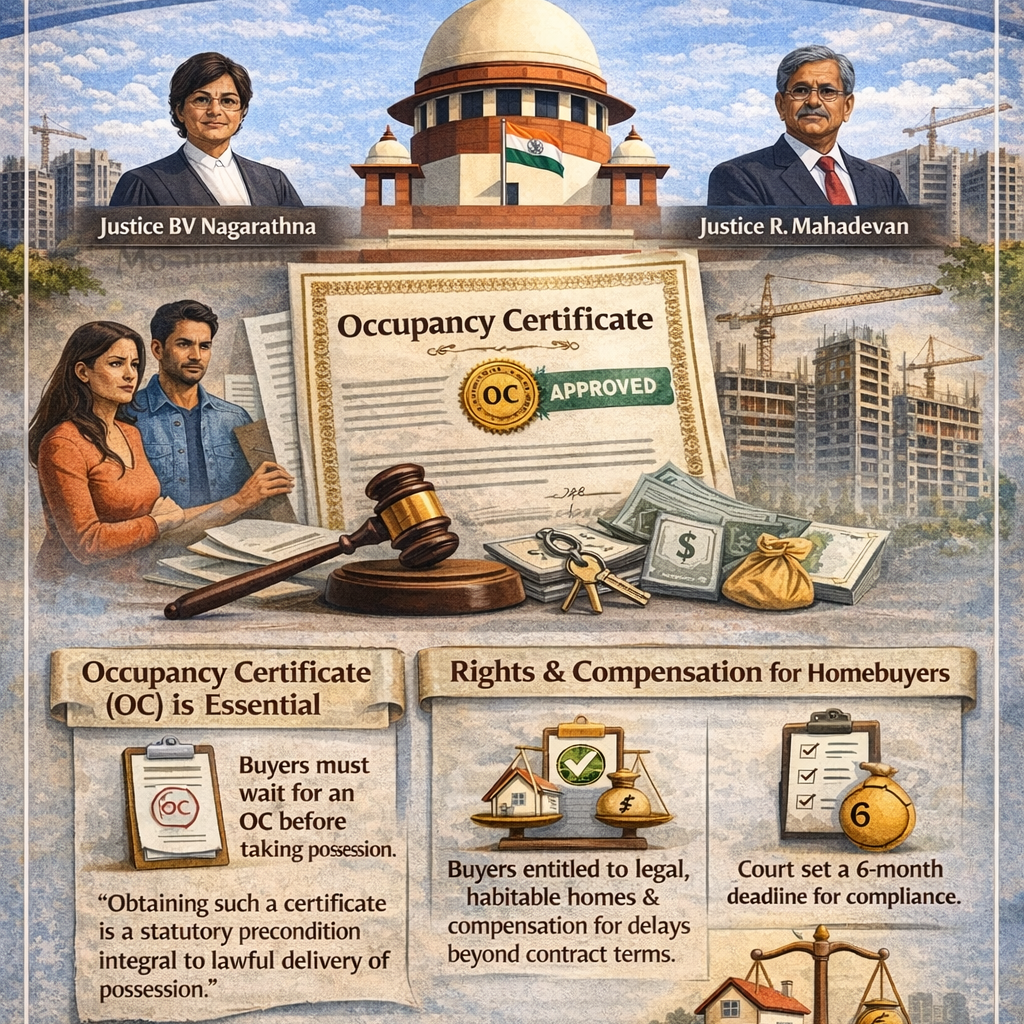
The Supreme Court ruled that homebuyers must wait until builders provide them with a genuine Occupancy Certificate (OC) before they can take possession of their purchased homes. The court determined that the developer’s inability to secure an OC demonstrates their failure to deliver promised services, thus making it a right to give compensation to the property buyers.
A Bench of Justice BV Nagarathna and Justice R Mahadevan established that a person must obtain an Occupancy Certificate because it functions as a legal requirement that establishes their right to possess property. The court rejected an appeal from Parsvanath Developers Ltd., which had postponed its OC acquisition for the Parsvnath Exotica project flats in Sector 53, Gurgaon.
The builder attempted to transfer possession of the property using an “as is where is” method, which required the certificate. Here’s what the Highest Court of the Country had to say:
“Obtaining such a certificate is a statutory precondition integral to lawful delivery of possession.”
Supreme Court Case Background and Builder Dispute
Homebuyers who bought flats between 2007 and 2011 and paid almost the complete sale price should have received possession of their flats between three and thirty-six months after their purchase.
The National Consumer Disputes Redressal Commission (NCDRC) received its case, resulting in two orders during 2018 and 2019 that instructed the builder to finish construction work and secure an OC and handover possession according to a defined schedule.
Supreme Court Observations on Compensation and Legal Compliance
The builder disputed this decision in the Supreme Court because he claimed that the compensation amount surpassed what the contract permitted.
The Supreme Court maintained the NCDRC ruling, which demonstrated that the builder’s delays constituted a service failure that permitted the Consumer Protection Act to require compensation payments that exceeded the terms of the contract. The Bench observed that consumer forums possess legal power to deliver fair and appropriate compensation, which contractual agreements that harm customers cannot nullify.
The court required the builder to obtain the occupancy certificate and transfer possession within six months from the time of the ruling. The NCDRC determined compensation must continue without any interruption until the specified date. The NCDRC will evaluate interest charges that occur after the designated period if genuine causes for delays emerge that do not link back to the builder.
Supreme Court Final Judgment and Impact on Real Estate Sector
The judgment further reinforces the principle that regulatory compliance in real estate is not optional but mandatory for ensuring lawful ownership and safe habitation. By insisting on the Occupancy Certificate before possession, the Supreme Court of India has underlined that homebuyers are entitled to not just a physical structure, but a legally approved and habitable residence. This interpretation strengthens consumer confidence in the housing sector and sets a clear benchmark for developers across the country.
In many instances, builders attempt to shift the burden of incomplete documentation onto buyers, often pressuring them to accept possession without fulfilling statutory obligations. The stance taken by the Supreme Court effectively discourages such practices and promotes accountability within the real estate industry.
Additionally, the ruling highlights the broader role of consumer protection mechanisms in safeguarding buyers against exploitation. By upholding compensation beyond contractual limits, the Supreme Court has affirmed that legal remedies must reflect fairness and equity rather than rigid adherence to biased agreements.
The decision is expected to influence future disputes involving delayed possession and incomplete project approvals. It establishes that statutory compliance, transparency, and timely delivery are fundamental obligations of builders, not optional commitments. Overall, this approach creates a more balanced real estate environment where both legal responsibility and consumer rights are properly protected.
Add a Comment