
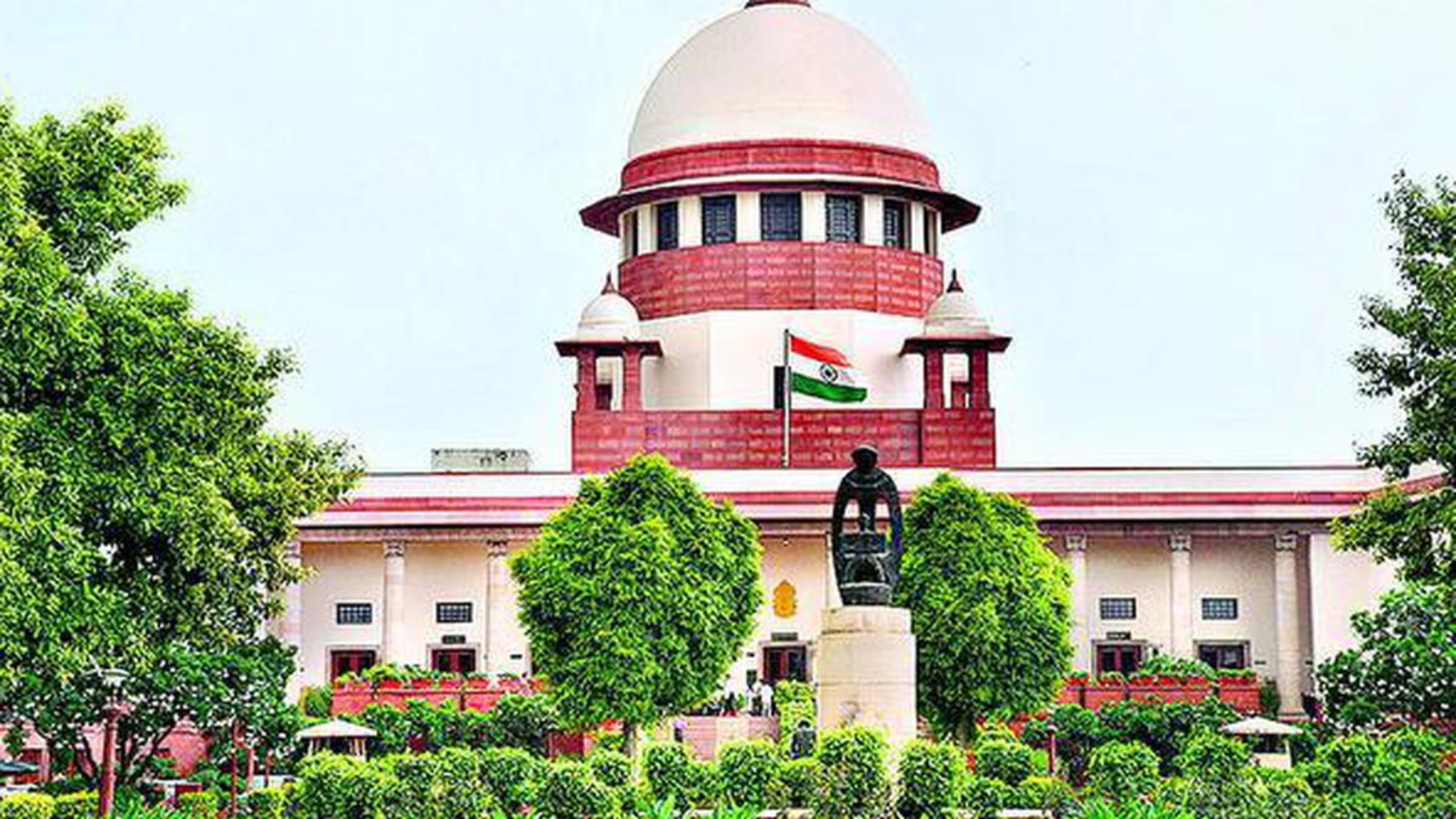
Supreme Court Rules RWAs Lack Locus Standi in Insolvency Proceedings
The Supreme Court of India has given its verdict that Resident Welfare Associations (RWAs) or homebuyers’ societies cannot be involved in the insolvency cases that are filed against the real estate developers. The court held that the associations lack the legal standing (locus standi) to take conclusive action as they are neither creditors nor representatives that have been officially authorized under the Insolvency and Bankruptcy Code (IBC).
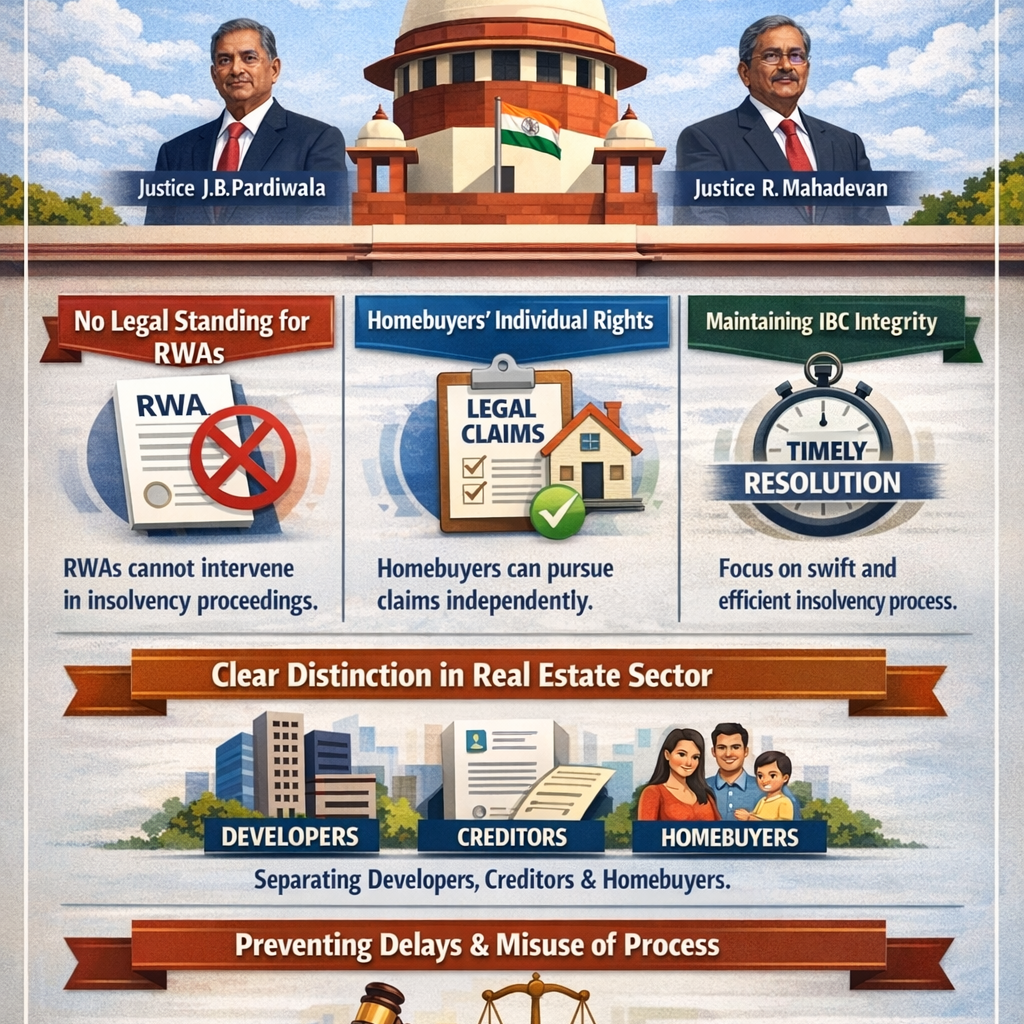
In the judgment, Justices JB Pardiwala and R Mahadevan pointed out that the RWA’s existence is primarily to operate and look after the common facilities in housing projects. The association members cannot legally represent all the homeowners in court unless the law gives them the power to do so or they have proper authorization. Allowing RWAs to take part in court would incorrectly broaden the definition of “financial creditor” and could encroach upon the individual rights of the homebuyers.
The Court cautioned that empowering RWAs would be a double-edged sword, as it would also allow the defaulter developers to misuse their power and prolong the insolvency process by pretending to represent the buyers’ collective interest. This would undermine the purpose of the insolvency process, which is meant to resolve financial defaults quickly and fairly.
This case revolves around Takshashila Heights India Private Limited, a real estate developer that took a loan of ₹70 crore in 2018 from ECL Finance Limited to launch the residential and commercial project “Takshashila Elegna” in Ahmedabad. Afterwards, the loan came under Edelweiss Asset Reconstruction Company Limited (EARCL). The developer’s failure to pay back the loan resulted in the account being classified as a non-performing asset in December 2021.
In the year 2023, the EARCL decided to take a chance and entered into a one-off settlement with the developer. But more defaults caused the settlement to be annulled and bankruptcy proceedings to be initiated. The National Company Law Tribunal (NCLT), while initially turning down the insolvency application, stated that the project was about to be finished and bankruptcy would be detrimental to homebuyers’ interests.
The NCLAT reversed this ruling by the NCLT, which granted the continuation of the insolvency process and denied the homebuyers’ society the right to intervene. Following that, both the developer and the society filed appeals to the Supreme Court.
The Supreme Court sided with the NCLAT in this matter. It made it clear that at the stage of admission in insolvency proceedings, the court’s only role is to verify the occurrence of financial default. The concerns of homebuyers, though very relevant, cannot be a reason to put off insolvency in case default is established.
The Court, furthermore, added that there are merely two participants in insolvency cases at the admission stage: the financial creditor and the corporate debtor. No third party, including the home’s organizations, has an automatic right to be listened to at this point.
Besides that, the Court decided that bankruptcy proceedings can carry on even if the creditors are taking recovery actions under other laws like the SARFAESI Act or at the Debt Recovery Tribunal. Though the use of multiple remedies at the same time may not be the best approach, it certainly is not illegal. Once insolvency is admitted, a legal moratorium stops all recovery actions. So, the Supreme Court dismissed the appeals and confirmed that RWAs cannot interfere in insolvency cases, and that insolvency law must be followed strictly as written.Supreme Court of India’s ruling significantly strengthens the framework of the Insolvency and Bankruptcy Code (IBC) by clearly defining the boundaries of participation in insolvency proceedings. The Court emphasized that allowing unnecessary parties to intervene could delay the resolution process and defeat the primary objective of the law, which is to ensure a time-bound and efficient resolution of financial distress. By restricting the role of RWAs, the Court has ensured that insolvency proceedings remain streamlined and focused.
Furthermore, the Court highlighted that individual homebuyers are not left without remedies. They are free to pursue their claims through legally recognized channels, either as financial creditors (if they meet the criteria) or through other appropriate legal mechanisms. However, an association cannot automatically assume the role of representing all buyers unless it has been explicitly authorized or recognized under the law. This clarification helps prevent ambiguity and misuse of representation in legal proceedings.
The judgment is also expected to have a broader impact on the real estate sector. It establishes a clear legal distinction between developers, creditors, and homebuyers, thereby reducing the chances of procedural complications. Legal experts believe that this ruling will discourage frivolous or strategic interventions that could otherwise be used to delay insolvency cases. At the same time, it reinforces the importance of following due process, ensuring that the rights of all stakeholders are protected within the framework of the law.
Add a Comment